

By Mfreke George ~ HSE Officer | Maritime Security & Safety Professional
“The best risk assessments are not the ones that satisfy auditors—they are the ones that prevent accidents before they happen.”
Introduction
Every major workplace accident begins long before the incident itself.
The collapse of a scaffold, a confined space fatality, a dropped object on an offshore platform, a chemical release in a processing plant, or a forklift collision inside a warehouse rarely occurs because organizations were unaware of the hazards. More often, investigations reveal that warning signs existed, hazards had been identified informally, and unsafe conditions had become normalized over time.

In nearly every serious incident investigation, investigators eventually arrive at the same conclusion:
The hazard was present. The controls were inadequate. The risk assessment failed—or was never truly carried out.
This reality explains why risk assessment is widely regarded as the cornerstone of every effective Health, Safety, and Environment (HSE) management system.
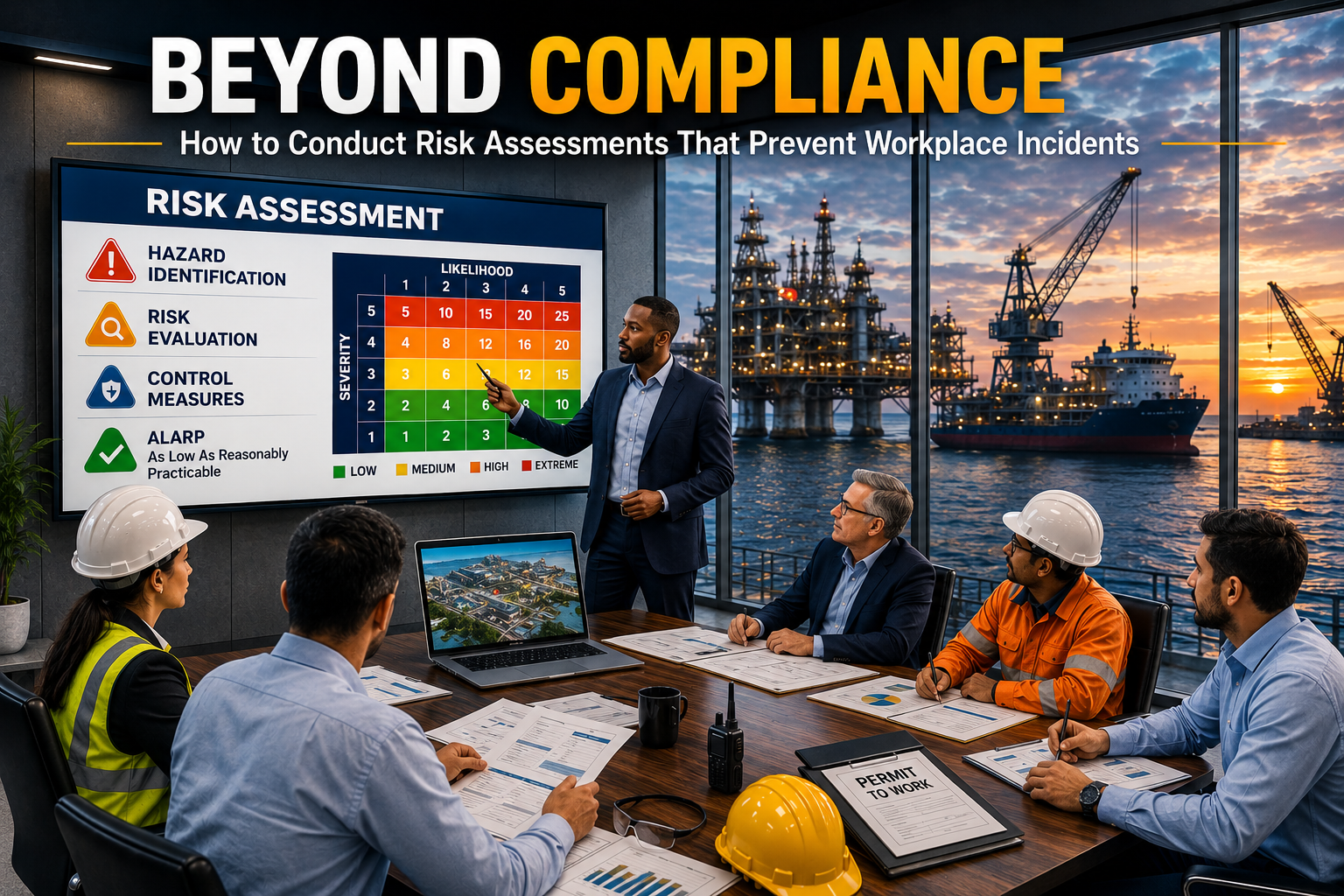
Risk assessment is not a document produced to satisfy regulatory requirements or pass an audit. It is a structured decision-making process that enables organizations to recognize hazards, evaluate operational risk, and implement controls before people, property, or the environment are harmed.
Organizations with mature safety cultures understand that effective risk assessments protect far more than compliance—they protect lives, preserve assets, improve operational reliability, strengthen business resilience, and enhance organizational reputation.
Whether you are managing an offshore installation, supervising a construction project, operating a manufacturing facility, coordinating logistics activities, or overseeing corporate operations, your ability to identify and manage risk will largely determine your organization’s safety performance.
Risk Assessment Is About Managing Uncertainty
One of the greatest misconceptions among new safety professionals is believing that risk assessments are designed to eliminate all risk.
This is neither practical nor achievable.
Every productive activity carries some degree of uncertainty. Driving to work, lifting heavy equipment, operating machinery, handling chemicals, or working at height all involve hazards. The objective of risk assessment is therefore not to eliminate every hazard but to reduce risk to a level that is As Low As Reasonably Practicable (ALARP) while enabling work to proceed safely.
This distinction is fundamental.
Organizations that pursue “zero hazards” often become frustrated because hazards are an inherent part of work. Organizations that pursue “effective risk management” focus their attention on controlling exposure, improving decision-making, and preventing incidents.
The question should never be:
“Is this workplace completely safe?”
The better question is:
“Have we identified the significant hazards, understood the associated risks, and implemented controls that are effective, practical, and sustainable?”
The First Mistake Most Risk Assessments Make
After participating in numerous workplace inspections and reviewing risk assessments across construction sites, manufacturing facilities, warehouses, maritime operations, and oil and gas projects, one recurring weakness becomes evident.
Many assessments begin with paperwork instead of observation.
The assessor sits in an office, opens an old template, changes the date, replaces the project name, and submits the document.
The assessment appears complete.
Unfortunately, the workplace has never been assessed.
Professional risk assessment begins with boots on the ground—not forms on a desk.
Before writing a single word, experienced HSE practitioners walk the worksite, observe the task, engage with workers, examine equipment, review environmental conditions, and ask a simple but powerful question:
“Show me how the job is actually done—not how the procedure says it should be done.”
The difference between these two realities often explains why incidents occur.
Workers frequently develop informal shortcuts, workarounds, and production-driven behaviors that are absent from written procedures. Unless these realities are identified, the assessment will fail to capture the true operational risk.
Looking Beyond the Obvious Hazards
New safety officers often focus on visible hazards—unguarded machinery, exposed electrical cables, or work at height.
Experienced practitioners look deeper.
They ask:
- What assumptions are we making?
- What changes could occur during the task?
- What happens if weather conditions deteriorate?
- What if communication breaks down?
- What if the operator becomes fatigued?
- What happens if a control fails?
This approach transforms hazard identification from a checklist exercise into critical thinking.
For example, during an offshore lifting operation, the crane may be fully certified, the lifting gear inspected, and the personnel competent. Yet if changing wind speeds are ignored, the suspended load can become unstable, creating a dropped-object hazard.
The equipment did not fail.
The risk assessment failed to consider changing environmental conditions.
This is why dynamic risk assessment—the continuous evaluation of changing conditions during work—is essential in high-risk industries.
The Risk Matrix Is a Tool—Not the Decision
One of the most common mistakes in industry is treating the risk matrix as the assessment itself.
Assigning numbers to likelihood and severity is useful because it helps prioritize actions, but numbers alone do not prevent incidents.
A “High Risk” rating means very little if the recommended control is simply:
“Workers should wear PPE.”
Professional assessments focus on the quality of controls, not merely the numerical score.
An experienced HSE professional asks:
- Can the hazard be eliminated?
- Can the task be redesigned?
- Can engineering controls remove worker exposure?
- Can automation reduce manual intervention?
- Are administrative controls realistic?
- Is PPE simply compensating for weak upstream controls?
Organizations with mature safety systems understand that PPE should be the final layer of protection—not the primary strategy.
Leadership Determines the Quality of Risk Assessments
The most effective risk assessments are not written by safety departments alone.
They are developed collaboratively by supervisors, engineers, operators, maintenance personnel, contractors, and frontline workers.
Safety professionals facilitate the process.
Operational leaders own the risk.
When leadership treats risk assessment as an operational tool rather than a compliance requirement, employees become active participants in hazard identification and continuous improvement.
A strong safety culture is built when every worker understands that stopping an unsafe task is not an act of disobedience—it is an act of professional responsibility.
My Final Submission
Every incident leaves behind a trail of warning signs that, if recognized and addressed in time, could have prevented harm. Effective risk assessment is the discipline of identifying those warning signs before they become headlines.
The organizations that consistently achieve outstanding safety performance are not those with the thickest manuals or the most impressive audit scores. They are the ones that embed risk-based thinking into everyday decision-making, empower workers to speak up, and treat every task as an opportunity to anticipate and control hazards.
Ultimately, risk assessment is not about completing forms—it is about protecting people, safeguarding assets, preserving the environment, and ensuring that work is completed safely, efficiently, and responsibly.
WATCH OUT FOR PART 2
Where I will discuss practically;
- Understanding the difference between hazards and risks.
- Common mistakes that weaken risk assessments.
- The practical five-step risk assessment process.
- Applying the Hierarchy of Controls effectively.
- Lessons from real-world operational environments.
- Building a risk-based safety culture that goes beyond compliance.
&&&&&&&&&&&&&&&&&&&&&
Mfreke George is a Maritime Health, Safety, Security, and Environment (HSSE) Professional with practical experience in occupational health and safety, maritime security operations, workplace risk management, and regulatory compliance. He has worked in safety-critical environments, supporting the implementation of risk assessments, incident prevention strategies, safety management systems, emergency preparedness, and security protocols. Passionate about promoting a proactive safety culture, he writes on workplace safety, maritime security, risk management, and operational excellence, helping organizations strengthen their safety performance, protect personnel and assets, and achieve international HSE best practice
At MNG MULTIBIZ, we believe that world-class safety begins with world-class thinking. By combining technical competence, operational discipline, and proactive leadership, organizations can move beyond compliance and build workplaces where safety is not merely a policy—it is a shared value that drives operational excellence.