
Testament Missionary Ministries
My heart bleeds over an issue that is silently weakening the missions movement and many para-church organizations today. It is individualism: the mentality of “my field,” “my ministry,” “my people,” instead of “our field,” and ultimately, God’s field.
This burden did not begin today. I painstakingly grew up observing this menace in the Church as a pastor’s son. I followed my father from one ministry station to another as he was transferred from place to place. Those years became my classroom, where I observed both the beauty and the brokenness within Christian ministry.
One incident has remained with me for many years. A Christian brother applied for a job, but another believer rejected his application—not because he lacked the qualifications, but simply because he was not a member of the same denomination. That experience exposed to me how deeply sectarianism had penetrated the Body of Christ.
My father would often comfort me by saying, “Mission is different.” He repeatedly reminded me that mission is collaboration, networking, and partnership. In missions, he believed, denominational walls should disappear because everyone is pursuing one objective—the advancement of the Kingdom of God.
Those words shaped my understanding of ministry.
By God’s grace, I eventually became a missionary myself.
Sadly, I have discovered that the disease of individualism has also found its way into many mission agencies and para-church organizations. The level of discrimination among some agencies and mission leaders is deeply alarming.
A fellow missionary may be struggling to survive while another agency has resources that could sustain or revive that worker. Yet help is withheld simply because, “He is not one of us.”
Opportunities are often reserved for “our missionaries.”
Training announcements circulate only within closed circles.
Scholarships are for our people.
International mission exposure is for our staff.
Funding opportunities are for our organization.
The question is: When did God’s mission become our private possession?
Mission fields are not private estates. They belong to Christ, the Lord of the harvest.
Many ministries have experienced unnecessary divisions because workers become territorial. New missionaries are viewed as competitors rather than co-labourers. Partnerships are resisted. Information is withheld. Successors are discouraged. Instead of strengthening the work, people spend their energy protecting what they believe is “their field.”
This attitude contradicts the very nature of the Gospel.
The Apostle Paul planted churches. Apollos watered them. Others continued the work. Yet Paul declared:
“Neither he who plants nor he who waters is anything, but only God who gives the increase.”
No missionary owns a tribe.
No pastor owns a congregation.
No organization owns a people group.
No ministry owns a nation.
We are merely stewards entrusted with God’s assignment for a season.
Another painful reality is becoming increasingly obvious today. Before a missionary can attend some mission conferences or symposiums, the cost is so high that it almost feels like attending a national political convention. Registration fees, transportation, accommodation, and other expenses make participation impossible for many frontline missionaries.
What about the missionary faithfully serving in a remote village?
What about the missionary whose monthly support barely feeds his family?
What about the missionary who has spent years translating Scripture, planting churches, or discipling believers in forgotten communities?
Should these faithful labourers be excluded simply because they cannot afford the cost of admission?
Ironically, these are often the very people whose voices, experiences, and lessons the global missions community most needs to hear.
Healthy mission organizations intentionally cultivate a culture where workers rejoice when others succeed, where leadership transitions are celebrated, where younger missionaries are mentored, and where collaboration is valued above personal recognition.
If mission truly belongs to God, then every faithful labourer deserves dignity, fellowship, encouragement, and opportunity—regardless of the logo on their identity card.
The harvest is too great, the labourers too few, and eternity is too urgent for territorial Christianity.
May God deliver us from the spirit of individualism and restore to His Church the beauty of genuine Kingdom partnership.
Let us return to the conviction that shaped the early missionary movement:
Mission is collaboration.
Mission is networking.
Mission is partnership.
Because the field is not mine.
The field is not yours.
The field belongs to Christ.
And we are simply privileged to labour together until the Lord of the harvest returns.
It will always be United we stand and build better. But divided we are falling daily but no one is taking notice since everyone is minding their “own” portions. Even with the divide and give me my own portions, we can’t even build it better. Why not we build and work together?
May the Lord give us wisdom and understanding.
Your brother,
M. N. George (Missionary)
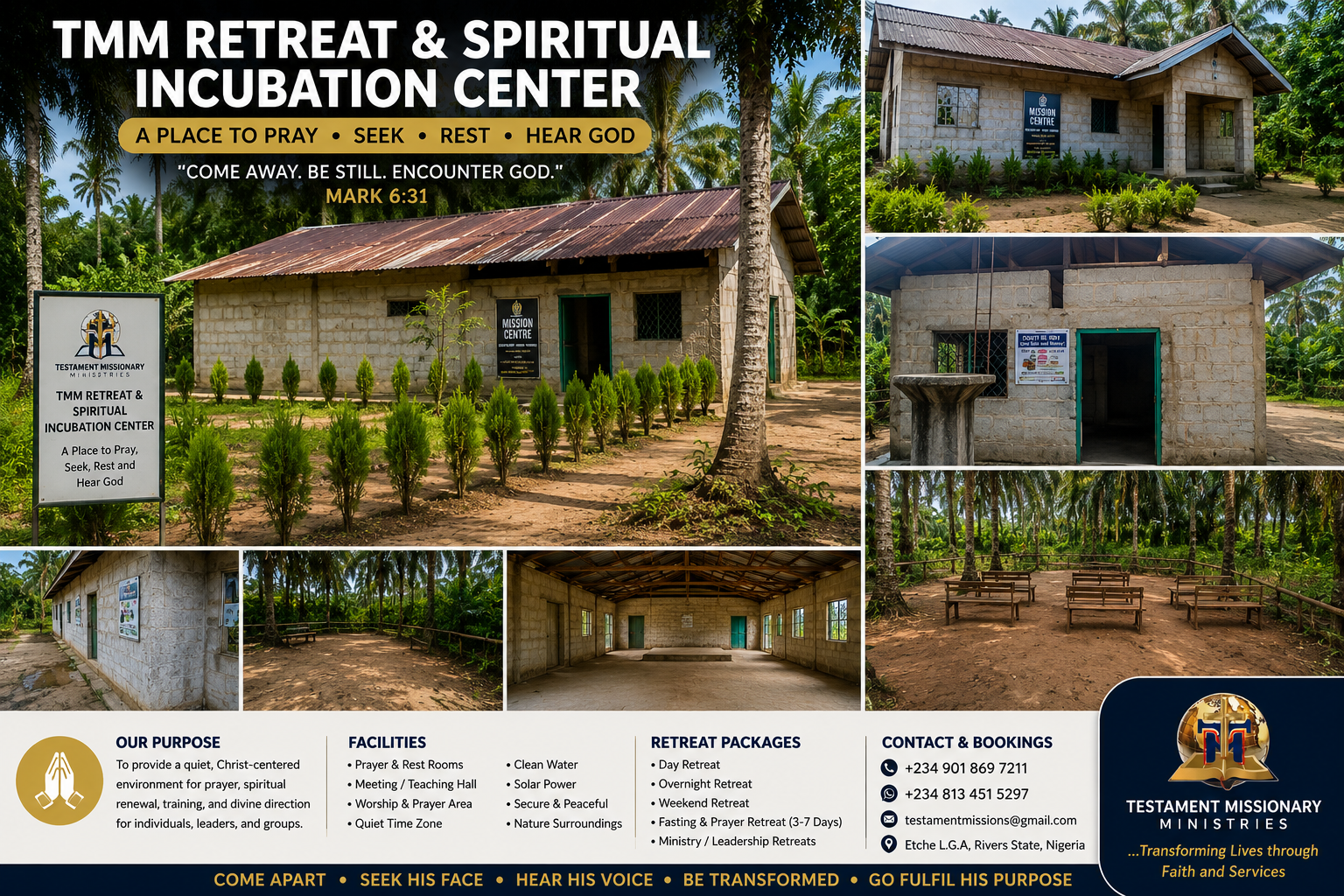
About Testament Missionary Ministries (TMM)
Testament Missionary Ministries (TMM) is a Christ-centered, interdenominational missionary organization committed to fulfilling the Great Commission by reaching unreached communities with the Gospel, making disciples, planting healthy churches, and raising transformational leaders. Through cross-cultural missions, leadership development, community outreach, and its Life-Restoration Discipleship model, TMM is dedicated to seeing lives, families, and communities transformed by the power of Jesus Christ.
With an already established missionary presence in Nigeria, Cameroon, Zambia, and Ghana, the ministry continues to press forward, expanding its mission frontiers into other African, Asian, and European nations through strategic partnerships, indigenous leadership development, missionary training, and sustainable mission initiatives.
Contact: testamentmissions@gmail.com