

By Rev. M. George
Founder & Publisher, MNGMultibiz
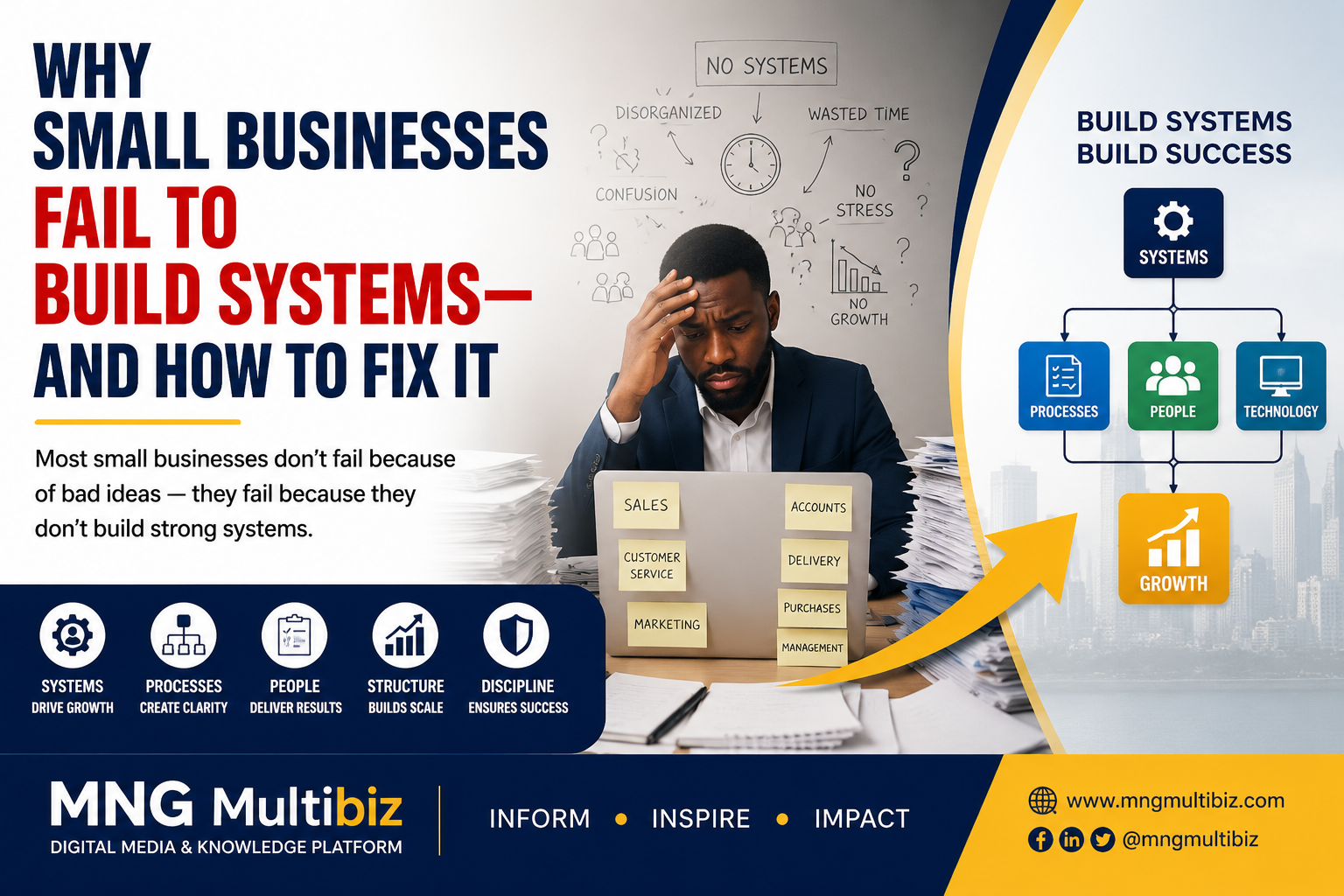
Many small businesses begin with passion, determination, and a brilliant idea. Yet, despite their potential, countless businesses struggle to grow beyond the owner’s daily involvement. The reason is often not a lack of customers, funding, or talent—it is the absence of systems.
A business without systems is simply a job disguised as an enterprise. The owner becomes the salesperson, accountant, marketer, customer service representative, operations manager, and sometimes even the cleaner. Such a business may survive, but it will rarely scale.
The Difference Between a Business and Self-Employment
Many entrepreneurs unknowingly create businesses that depend entirely on them. If they are absent for a week, operations slow down. If they become ill, the business almost comes to a standstill. This is not sustainable.
A true business is one that can function efficiently because clear processes, capable people, and defined responsibilities are in place.
Why Small Businesses Fail to Build Systems
1. Everything Depends on the Owner
Many entrepreneurs believe no one else can do the job as well as they can. While this may be true initially, refusing to delegate limits growth. A business cannot expand if every decision must pass through one person.
2. Lack of Standard Operating Procedures
When tasks are carried out differently each day, consistency becomes impossible. Customers receive varying experiences, mistakes increase, and employees become confused because there is no documented way of doing things.
Every growing business needs written procedures that explain how work should be done.
3. Poor Record Keeping
Some business owners rely on memory instead of maintaining proper financial records, inventory reports, customer databases, and operational documents.
Without accurate records, it becomes difficult to measure performance, identify problems, or make informed decisions.
4. Hiring Without Structure
Many small businesses employ people without clearly defining their responsibilities. Employees begin work without job descriptions, performance expectations, or accountability measures.
When roles are unclear, productivity suffers.
5. Ignoring Technology
Technology is no longer a luxury for businesses—it is a necessity.
Businesses that continue to rely entirely on manual processes often waste valuable time and resources that could be saved through simple digital tools.
6. No Long-Term Vision
Some entrepreneurs focus only on today’s sales rather than building a business that can grow over the next five or ten years.
Without a clear vision, it becomes difficult to develop systems that support long-term expansion.
How to Build a Business That Works
- Create Written Processes
- Document how every important task should be completed.
- From customer service to product delivery, every process should have a clear, repeatable method.
Build the Right Team
- Recruit people whose skills complement your business goals.
- Train them, empower them, and hold them accountable for results.
Define Roles Clearly
Every employee should understand:
- What they are responsible for.
- Who they report to.
- How their performance will be measured.
Clarity reduces confusion and improves efficiency.
This very process took me a whole lot to put in place for our team at MNG MULTI-BIZ GROUP
Organize Your Records
Maintain proper documentation for:
- Sales
- Expenses
- Inventory
- Customer information
- Staff records
- Operations
Reliable information is essential for sound decision-making.
Invest in Technology
Simple tools for accounting, customer management, communication, and project tracking can significantly improve efficiency and reduce operational errors.
Review and Improve Regularly
Business systems should never remain static.
As your organization grows, continuously evaluate your processes and improve them where necessary.
My team knows me for this. We constantly review our systems and structures in every two yearly intervals.
Systems Build Freedom
The ultimate goal of building systems is not to remove the owner from the business but to remove unnecessary dependence on the owner.
When systems are in place:
- Customers receive consistent service.
- Employees understand their responsibilities.
- Decisions become easier.
- Operations become more efficient.
- Growth becomes sustainable.
A business that depends entirely on one individual has limited potential. A business built on effective systems can continue creating value regardless of who is present. I learned this in a hard along the process of building MNG GROUP.
My Final Thoughts
Great companies are not built solely on great products—they are built on great systems.
If your business cannot operate successfully without your constant supervision, it is time to shift your focus from working in the business to working on the business.
Begin documenting your processes. Build capable teams. Invest in structure. Embrace technology. Develop a long-term vision.
The businesses that endure are not necessarily the ones with the best ideas; they are the ones with the strongest systems.
Your business deserves more than survival—it deserves to grow, scale, and outlive you.
Rev. M. George ~ Founder & Publisher, MNGMultibiz. Founder & CEO MNG GROUP COMPANIES 
MNGMultibiz
Inform • Inspire • Impact
