The organizations that thrive in the AI era will be those that redesign work, invest in people, and lead transformation with purpose
Executive Review | MNG MULTI-BIZ
Artificial intelligence has rapidly become one of the defining forces shaping the global economy. Boardrooms are investing heavily in AI, governments are racing to develop national AI strategies, and employees are increasingly questioning what the technology means for their careers.
The prevailing narrative suggests that AI will inevitably replace millions of jobs. It is a compelling headline, but it is an incomplete one.
 The more consequential story is not that artificial intelligence is replacing work. It is that AI is redefining the nature of work itself. The organizations that emerge as leaders in this new era will not be those that simply deploy AI tools, but those that fundamentally rethink how people, technology, and strategy create value together.
The future of work will be determined less by artificial intelligence than by the quality of leadership guiding its adoption.

The Wrong Question
For much of the public conversation, AI has been framed as a contest between humans and machines.
This is the wrong question.
History demonstrates that transformative technologies rarely eliminate entire professions overnight. Instead, they reshape industries by automating specific tasks, creating new capabilities, and raising expectations for productivity and innovation.
Artificial intelligence follows this same pattern.
Routine administrative functions, repetitive analytical work, and predictable operational tasks are increasingly being automated. At the same time, demand is growing for capabilities that machines struggle to replicate—strategic thinking, ethical judgment, creativity, relationship management, leadership, and complex decision-making.
The competitive divide will not be between organizations that use AI and those that do not. It will be between organizations that redesign work around human-AI collaboration and those that merely digitize existing processes.
From Automation to Augmentation
Many executives initially viewed AI as a cost-reduction tool.
That perspective is becoming increasingly inadequate.
Leading organizations are discovering that AI’s greatest value lies not in replacing employees but in enhancing their capabilities. Professionals can process information faster, identify patterns more effectively, and make better-informed decisions when AI is integrated into well-designed workflows.
This shift from automation to augmentation represents a profound change in management thinking.
Technology is no longer simply reducing labour; it is expanding human capacity.
Organizations that understand this distinction are moving beyond efficiency gains toward sustained competitive advantage.
 The Emerging Skills Economy
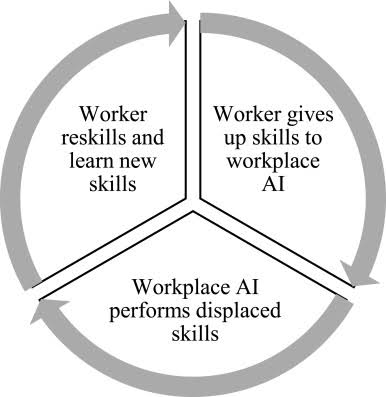
Artificial intelligence is transforming the labour market by changing which skills create value.
Technical expertise remains important, but it is no longer sufficient on its own.
As AI assumes more routine cognitive tasks, human capabilities such as critical thinking, adaptability, communication, collaboration, emotional intelligence, and ethical leadership become increasingly valuable.
These are not “soft skills.”
They are strategic capabilities that enable organizations to navigate uncertainty, build trust, and make sound decisions in increasingly complex environments.
The workforce of the future will not be defined by those who compete against AI but by those who learn to work effectively alongside it.
Job Security Is Becoming Skills Security
For generations, job security was closely associated with tenure, organizational loyalty, and stable employment.
That model is rapidly evolving.
Today’s professionals derive security less from the position they hold than from the relevance of the skills they possess.
Continuous learning has become an economic necessity rather than a personal preference.
Organizations therefore face a strategic choice.
They can treat AI as a substitute for talent, or they can invest in reskilling and upskilling their workforce to unlock greater productivity and innovation.
The latter approach is increasingly proving to be the more sustainable path.
Leadership Determines the Outcome
Technology does not transform organizations.
Leadership does.
The success or failure of AI integration depends largely on executive decisions about governance, workforce development, organizational culture, ethics, and change management.
Employees rarely resist technology itself.
More often, they resist uncertainty, inadequate communication, and the fear of becoming obsolete.
Leaders who address these concerns with transparency and investment in people create environments where innovation is embraced rather than feared.
Trust, not technology, becomes the foundation of successful transformation.
The New Competitive Advantage
The next generation of successful enterprises will not be defined solely by the sophistication of their AI systems.
Their advantage will come from integrating artificial intelligence with human intelligence.
Organizations that combine data-driven insights with ethical leadership, creativity, collaboration, and sound judgment will outperform those that rely on automation alone.
Artificial intelligence can accelerate decisions.
It cannot replace wisdom.
It can generate information.
It cannot determine purpose.
It can analyse patterns.
It cannot inspire people.
These uniquely human capabilities remain central to sustainable organizational success.
A Defining Moment for Business
Every technological revolution reshapes the relationship between organizations and their workforce.
The AI revolution is no different.
The defining challenge for executives is no longer deciding whether artificial intelligence should become part of the business.
That decision has largely been made.
The greater challenge is determining how AI can enhance human potential while preserving trust, dignity, accountability, and long-term organizational resilience.
This requires a shift from technology-first thinking to leadership-first thinking.
Organizations that make this transition will not merely survive the AI era.
They will help define it.
Conclusion
Artificial intelligence is transforming industries, but its greatest impact will not be measured by the number of jobs it replaces.
It will be measured by the quality of organizations it helps create.
Businesses that invest in technology while neglecting people may achieve short-term efficiency but risk long-term fragility.
Those that integrate AI with visionary leadership, continuous learning, and strategic workforce development will build organizations capable of sustained innovation and enduring competitive advantage.
The future of work is not a choice between humans and machines.
It is a choice between organizations that adapt intelligently and those that remain anchored to yesterday’s assumptions.
Executive Insight | MNG MULTI-BIZ
“Artificial intelligence will not determine the future of work. Leadership will determine whether AI becomes a force for human advancement or organizational disruption.”