

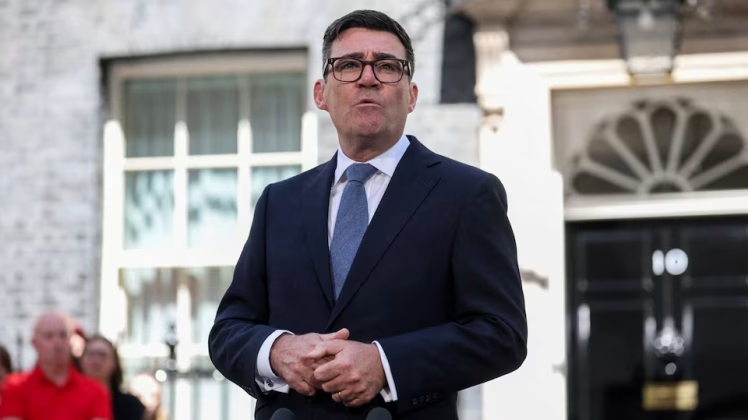
Britain’s new Prime Minister, Andy Burnham, pledged on Monday to end years of political instability and weak economic performance by introducing a new political and economic model, promising reforms aimed at restoring public confidence, driving growth and delivering long-term stability.
Speaking outside 10 Downing Street shortly after taking office, Burnham acknowledged widespread public frustration with politics and said previous governments had failed to provide the certainty needed to improve living standards.
“I know people at home are fed up with politics. I hear you, and I want to be honest with you, we have not been good enough and we need to be better,” he said.
The 56-year-old Labour leader described his administration as a decisive break from recent political turbulence, pledging what he called the most significant changes in four decades.
“We will make this moment a circuit-breaker for Britain, bringing forward the biggest changes in the last 40 years. A new political model and a new economic model,” Burnham said.
His remarks came after former Prime Minister Keir Starmer delivered a farewell address, describing his time in office as “the privilege of my life” and offering his support to his successor.
Burnham’s government inherits a range of challenges, including sluggish economic growth, a prolonged cost-of-living crisis, pressure on public services and concerns over struggling utility companies. He said one of his immediate priorities would be tackling rough sleeping, while also introducing measures to ease financial pressures on households.
The prime minister also announced plans to expand public housing, arguing that increased housing supply could reduce welfare costs and create fiscal space for higher defence spending at a time of growing security concerns across Europe.
Later this year, Burnham intends to unveil a 10-year “Plan for Britain,” setting out a long-term strategy for economic and social renewal.
“I will bring forward a new Plan for Britain, a 10-year plan, laying out a plan from where we are now to where I believe we all want Britain to be, wherever we’re coming from, whatever party we support,” he said.
His election as Labour leader has been viewed by supporters as a significant shift in British politics, with many believing he can counter the rising influence of Nigel Farage’s Reform UK party and reconnect mainstream politics with disillusioned voters.
Burnham also pledged to make “life more affordable” and ensure that “all people and places are lifted from where they are now,” framing his agenda as an effort to spread economic opportunity more evenly across the country.
One of his first tests in office will be appointing a cabinet, particularly a finance minister, a position widely regarded as critical to the success of any British government. His administration has already moved to cancel plans requiring workers to hold digital identity documents, a policy that had faced criticism from lawmakers.
As Burnham begins his premiership, investors, political observers and international partners will closely watch how his government approaches taxation, public spending, energy policy and proposals for greater public control of struggling utility providers—issues that could shape Britain’s economic trajectory for years to come.
