
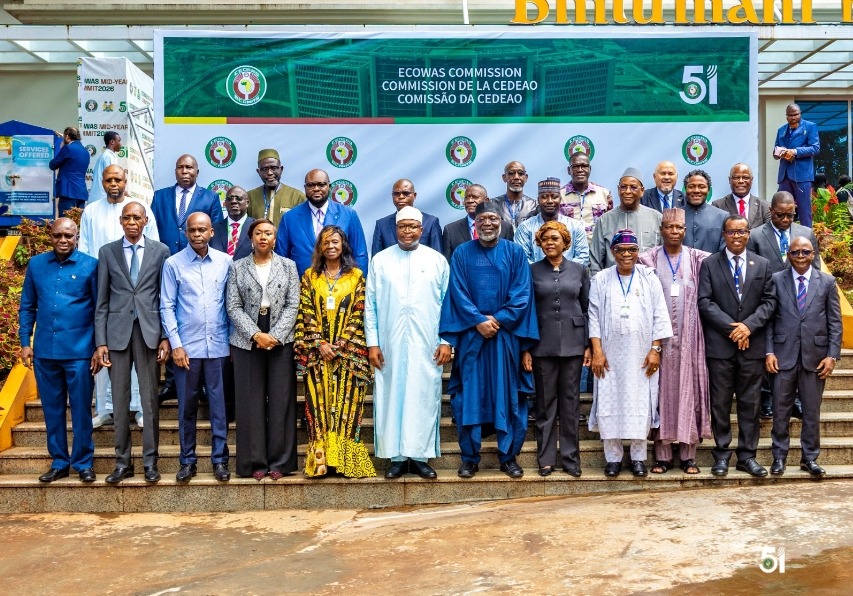
The Economic Community of West African States (ECOWAS) has reaffirmed its commitment to regional integration, peace and economic cooperation despite growing political, security and economic challenges across the region, as ministers and leaders gathered in Freetown, Sierra Leone, for key policy meetings.
Addressing the 96th Ordinary Session of the ECOWAS Council of Ministers and the Ordinary Session of the ECOWAS Authority of Heads of State and Government, ECOWAS Commission President Dr Omar Alieu Touray said the bloc remained resilient and focused on strengthening cooperation among its member states amid changing regional realities.
Touray highlighted major achievements recorded during his four-year tenure, including the operationalisation of the Permanent Representatives Committee, the commissioning of the Mfum-Ekok Bridge and Joint Border Post linking Nigeria and Cameroon, the establishment of the ECOWAS Business Council, and the relocation of the Commission to its new headquarters in Abuja, Nigeria.
“Despite these challenges, we have continued to strengthen the foundations of regional integration,” Touray said. “These milestones reflect our collective determination to build stronger institutions capable of serving the people of West Africa more effectively.”
He called on ministers to provide strategic direction on governance, financial sustainability, regional integration and emerging policy priorities, expressing confidence in ECOWAS’ capacity to advance peace, stability and sustainable development across the region.
The meeting comes at a critical time for West Africa, which faces security threats from armed groups, democratic governance challenges, economic pressures and shifting geopolitical dynamics. These issues have tested regional cooperation and underscored the importance of effective multilateral institutions.
In his opening remarks, Sierra Leone’s Minister of Foreign Affairs and International Cooperation, Timothy Musa Kabba, who chairs the ECOWAS Council of Ministers, urged member states to strengthen unity and collective action in addressing the region’s evolving challenges.
He called on ministers to deliver “practical, results-oriented recommendations on regional integration, peace and security, economic development and institutional reforms” that would guide decisions by the Authority of Heads of State and Government.
Kabba also reaffirmed Sierra Leone’s commitment to promoting a peaceful, democratic and fully integrated West Africa through dialogue, cooperation and shared responsibility.
During the two-day meeting, ministers reviewed the financial status of the regional bloc, assessed the security and political situation across member states, and considered policy proposals including an action plan for the return of cultural property to countries of origin between 2027 and 2030.
They also discussed measures to operationalise the ECOWAS Economic and Social Council (ECOSOCC) and strengthen regional governance mechanisms.
Founded in 1975, ECOWAS is one of Africa’s most influential regional organisations, bringing together West African nations to promote economic integration, political stability and collective security.
